July 14, 2014

Pakse (Day 2)


July 14, 2014 ----Pakse is just a small city located in southern Laos. It's the capital of Champasak Province, founded by French colonialists in 1905. To get there from Thailand, you can either fly from Bangkok or take a bus from Ubon Ratchathani. If you travel by bus, there is a visa-on-arrival service at the border, but the visa and entrance fees can fluctuate as corruption is well known there.

Nathan and I spent our second day in Pakse strolling around the small city and hiking up to the giant Buddha statue on top of the mountain. Because we didn't know how to ride a motorcycle and there wasn't any bicycle for rent, we could only rely on our feet. Luckily the city wasn't big, and there really wasn't much to see in the city center.

We started at Wat Luang located just a block from our hotel. It's a Buddhist temple built in 1935 and serves as a college for monks as well. Nathan and I went inside the chapel ("Phra Ubosod" in Thai) to pay respect to the Lord Buddha statue inside. We met a Buddhist monk as he had his "office hour" there to greet and bless visitors. He explained the Buddhist Sangha and education in Laos to us and told us that most monks have to travel to Bangkok if they want higher education. He also gave us "Sai Sin" or a holy string wrapped around our wrist.

Then we strolled along the Mekong River and stopped for lunch at one of the riverside restaurants. A lot of locals liked to come here with their peers eating and drinking while overlooking the gorgeous view of mountains and river. Nathan and I ordered some local dishes like grilled river fish, papaya salad, etc. All was good and at a reasonable price.

The weather was very hot, bright and sunny when we were there, but a thunderstorm was to be expected in the evening. We walked across the Lao-Nippon Bridge (built in the years 1997-2000) to the other side of Mekong River. The bridge was funded by the Japanese government and it's a little over a kilometer long. There were pedestrian walks on both sides of the bridge that kept us safe from the traffic.

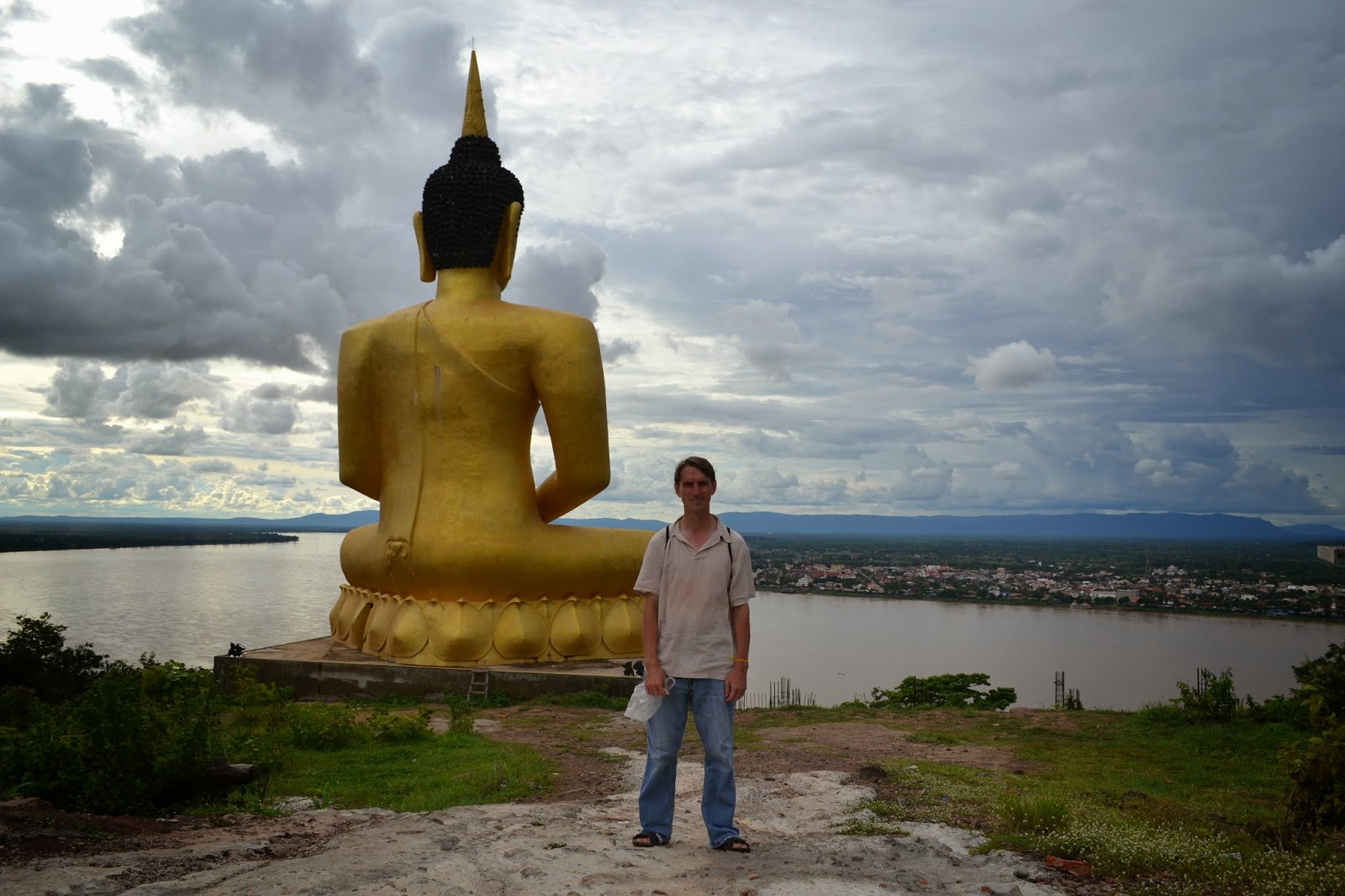
On the other side of the Mekong River was a mountain where the "Big Buddha" statue was situated. It's about 10 meters tall, and we could get there by climbing up on wide concrete steps that later become narrow wooden steps all the way to the statue. The "Big Buddha" overseeing Pakse City is a beautiful scene, especially with thunderstorm clouds hanging over the city. I would describe it as a "Peace in the Chaos" scene.

There was a Buddhist monastery right behide the Big Buddha. Nathan and I went inside the chapel and stayed there wishing the rain would come and be over before we departed the temple and walked back to the city. However, the storm seemed to delay and we couldn't wait any longer, so we ended up walking in the rain when we were on the Lao-Nippon Bridge. It was very scary because I was afraid of lightening and thunder, but we had no choice; we had to cross the bridge!

We were soaking wet but on the other side we were safe from being killed in the storm. :-)


Wat Luang


Lao-Nippon Bridge


"Big Buddha"


July 13, 2014

Pakse (Day 1)


July 12-13, 2014 ---- Pakse is a remote city in southern Laos. It's well known for many beautiful waterfalls and Wat Phu, a ruined Khmer temple complex built in the 11th to 13th centuries. To get to Pakse from Thailand is very easy. There are direct buses running from Ubon Ratchathani to Pakse and vice versa twice a day. The tickets are only sold on the same day, no early reservations can be arranged, and you should get there early because it can fill up quickly.

Nathan and I took an afternoon bus from Ubon Ratchathani Bus Terminal and it was very crowded and many people had to sit on the floor. We arrived Pakse around 7 p.m. and were squeezed in a TukTuk with other tourists to Phi Dao Hotel, where we stayed for 4 nights. The room was nice, clean and spacious, and the hotel has a restaurant in the lobby area. I would say that many things in Pakse were more expensive than I had expected, especially food and transportation.

Our first full day in Pakse was very adventurous. We couldn't ride a motorcycle and there was no bicycle for rent, and we tried to avoid hiring a TukTuk or tour van because we weren't good at talking the price down (A must have skill in Lao). As a result, we strolled along the Mekong River all the way to Daoruang Market to take a local bus (called Song-Taew) to Wat Phu.

In fact there wasn't really any Song-Taew that runs between Pakse-Wat Phu, but we found one that went to Champasak and the driver agreed to go a few extra miles to drop us off in front of Wat Phu. Lucky us! The ride took about an hour. The scenery along the way was gorgeous. People were working in their farms and rice fields. Water buffaloes were dipping in the mud. Many clouds hanging low over mountains....

Once we got to Wat Phu, we went to lunch at a local noodle shop located right in front of the entrance. Then we bought tickets (50,000 kip each) which included the ride on a golf cart to and from the temple and a museum entrance fee.

I don't really know much about Wat Phu or Vat Phou other than that it's a ruined Khmer temple. From what I saw at the sight, it was kind of a mix of Buddhism and Hinduism. There were a lot of Hindu god images carved on stone and concrete around the ruins, and there was a big Buddha statue sitting in the main temple building on the mountain. The view from the hill was breathtaking, and climbing up there wasn't too difficult. Nathan and I spent about an hour in the ruin area before going back down to the museum located right at the entrance. It was a nice, little museum.

Then the problem was we couldn't find any TukTuk or Song-Taew back to Pakse City. The bus from Champasak to Pakse only runs in the morning. I started looking around at other tourists who drove to the temple, and I found one Thai family who also stayed in a hotel in Pakse, and they agreed to give us a ride back to town. What a relief!

In Pakse, there was one Indian restaurant right around the corner form Phi Dao Hotel that was really good. Highly recommend if you visit Pakse.


A typical breakfast in Laos


People from outside of town come to "Daoruang Market" for their household supplies

Pakse Bridge over Mekong River

The road to Wat Phu


A water buffalo eating his lunch

Farmers working in their rice field.

Rice paddies


Champasak Village

The local bus we took from Daoruang Market to Wat Phu.

Lunch!


 Wat Phu


Dinner at our favorite Indian restaurant in Pakse City